How Is Trading Futures Different?

A futures contract is an agreement to trade something at a set date, traded now. It has an expiry, so a position has to be closed or rolled; its leverage is a property of the contract rather than a setting; and margin is enforced on the exchange's schedule, not on your view of the trade.
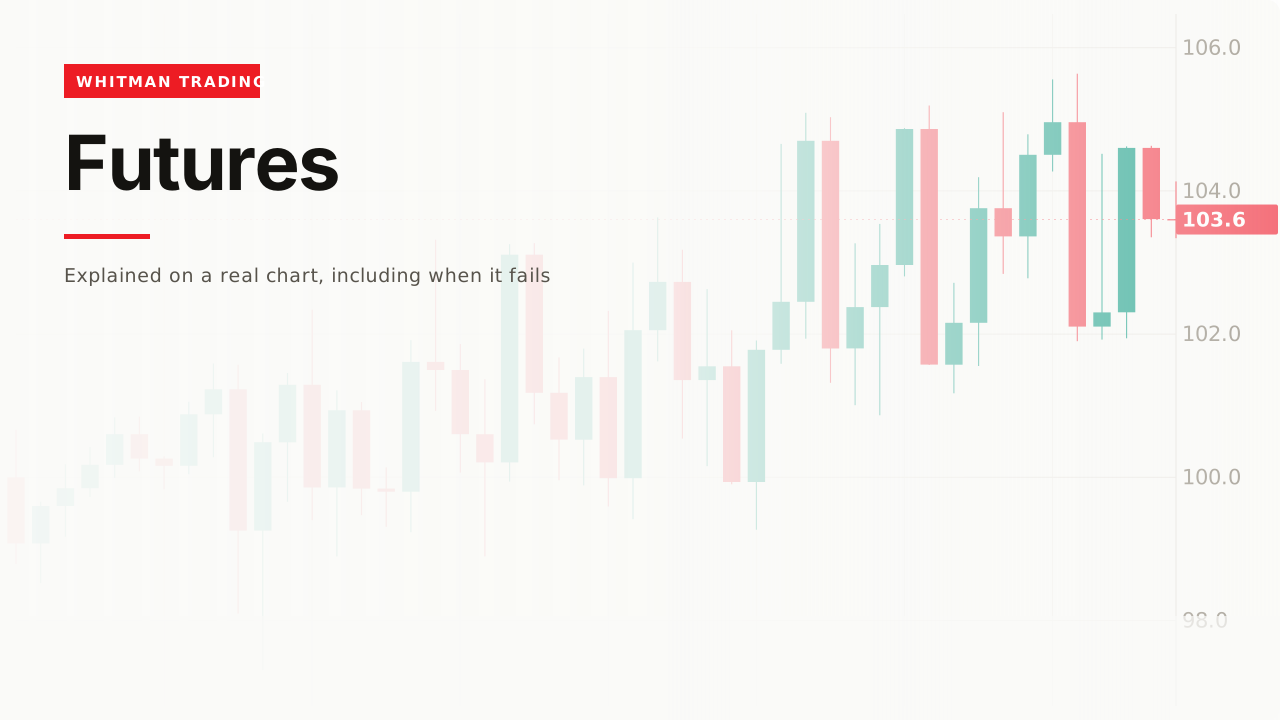
The chart is a chart. What makes futures different is that the instrument has a calendar and a built-in multiplier, and neither of those appears anywhere on it.
How it works

A futures contract is an agreement to exchange something at a specified date. What trades today is the price of that agreement.
Each contract is for a fixed quantity — a set number of barrels, bushels, currency units or index points — so the position size is chosen in whole contracts rather than freely.
And the technical method is unchanged. Levels, structure and indicators are arithmetic on prices, and these are prices.
One: it expires

A contract stops existing on a date. To hold a position beyond it you close the expiring contract and open the next one, which is called rolling.
The two contracts are not at the same price. So a chart of “the front contract” contains discontinuities at every roll unless the data has been adjusted — and adjusted data has had its prices altered, which means a level read off it may not be a price that ever traded.
That is a real trap for level-based work, and the fix is knowing which kind of chart you are looking at before you draw anything on it.
Two: the leverage is built in

You post margin — a deposit — and control the contract’s full notional value.
Which means there is no leverage slider to leave alone. A single contract is already a leveraged position, and the multiple depends on the contract’s size and the deposit required, not on anything you selected.
So the leverage arithmetic is not optional here. Work out what one ordinary bar is worth in your account before the first trade: at 20 times, the page measures one typical bar as about a third of the account.
The right response is the same as everywhere: place the stop, size from it, and read the leverage off as a consequence — which in futures means deciding whether you can trade one contract at all.
Three: margin runs on a schedule

Positions are marked to market and margin is enforced by the exchange and the broker on their timetable.
Which produces a failure that has nothing to do with analysis: a position can be closed at the worst point of a move that then goes exactly where you expected, and the position no longer exists to benefit.
Being liquidated is not the same as being wrong. It is the specific hazard of a leveraged instrument, and the only defence is size.
Four: the volume is real

Futures trade on an exchange with a consolidated tape, so the volume figure is a genuine count.
This is why serious volume profile and market profile work is usually done on futures — both tools need a real volume series and a real session, and futures have both.
It is also why futures charts are used as a reference for markets that lack them: currency futures for forex, index futures for the cash index.
The one genuine advantage
Beyond the volume data, futures have a structural feature worth naming: the contract is standardised and centrally cleared.
Everyone is trading the same object. A level on a futures chart is a level everyone else can see on the same contract, at the same price, with the same tick size — which is not true of spot forex, where every broker quotes its own book, or of crypto, where every venue does.
That matters for exactly the reason the support and resistance page gives. A level works because orders cluster at it, and orders cluster at prices everybody is looking at. A single shared order book is the strongest version of that condition available.
The cost of the advantage is the size. One standardised contract is as small as the position gets, and if that is too big for the account, the advantage is not available to you yet.
A worked example

Find the contract’s tick size and tick value. That converts a chart distance into money, and nothing else on this page works without it.
Work out what one ordinary bar is worth in your account.
If a single contract puts more than a small percentage of the account on one bar, this is not an instrument you can trade yet — and that is a size answer, not a skill answer.
Then check the expiry and the roll date before taking anything you intend to hold.
The original data
Across our study of 24,971 trading videos, 343 cover futures. The median one gets 1,639 views, 85% never pass 50,000, and the median length is 16.2 minutes — a long median on a poorly-watched subject.
That 1,639 is one of the lowest medians measured in this glossary — below penny stocks at 2,758 and far below crypto at 21,437, on a larger field than either.
The corpus carries description text for only 14 of those 343, which is too thin to say anything about how the topic is written, and this page does not.
When it fails
The chart was adjusted and the level was not real
A back-adjusted continuous contract shifts historical prices so the series joins up. It is the right chart for measuring moves and the wrong one for reading a level that traded years ago.
You were leveraged without deciding to be
One contract is a position size, and it may be a much larger one than the account can carry. This is the most common way futures go wrong for people arriving from shares.
Margin was called on a correct trade

The path matters as much as the destination once leverage is involved, which is why the risk per trade arithmetic comes before any of the analysis.
The roll was forgotten
A position held into expiry does not quietly continue. It is closed, or in some contracts it becomes a delivery obligation, and neither is a thing to discover on the day.
You judged it from the finished chart

Nothing on the chart says which of those three is right, because the answer depends on the calendar and the account rather than on the price.
Related
Leverage is the arithmetic that makes a contract’s built-in multiple survivable.
Nasdaq trading is where index futures and a cash index sit side by side.
And risk per trade is the sizing rule that has to come first when the instrument chooses the leverage for you.
The mistake I made here was assuming that because I had not touched a leverage setting, I was not using leverage. A futures contract controls a large notional value for a small deposit whether you think about it or not, and the first time that was explained to me properly was after it had already cost me.
— Michael Whitman, from this video
This page is educational, not financial advice. Test every idea on your own charts before risking money.