What Is Day Trading?

Day trading means opening and closing positions within a single session, so nothing is held overnight. It sits between scalping and swing trading: larger moves per trade than scalping and lower transaction cost as a share, in exchange for giving up anything that happens outside the session.
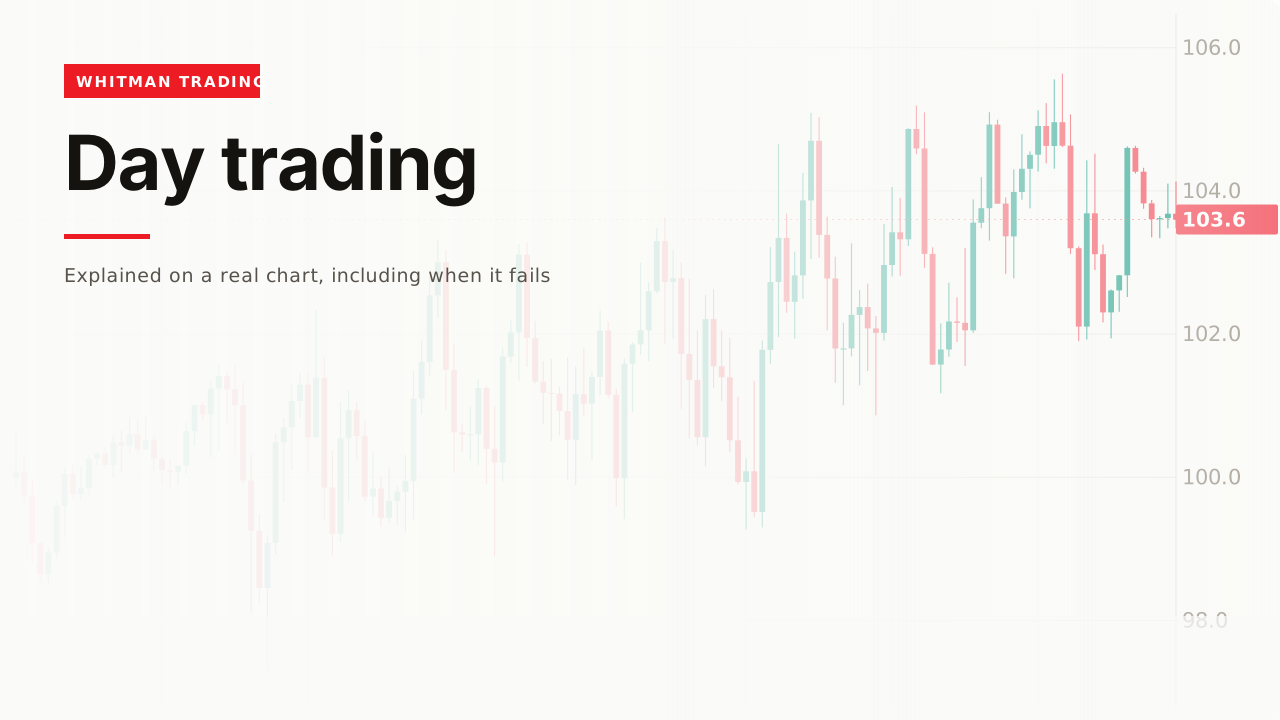
The four style pages here are four aggregations of one price history, so the numbers below can be compared directly with the other three. This is the second-fastest view.
How it works

Open and close inside one session. Nothing carries.

That rule is the definition, and it is not about speed. A day trader taking two positions a session is still day trading; someone holding a scalp for three days is not.
What the timeframe buys

The typical bar covers 1.17 — 2.4 times the fastest view of the same market.
So the same 0.02 round trip is 1.7% of a bar instead of 4.1%. One step slower cuts the cost share by more than half, and nothing else changed.
| Style | Bars | Typical bar | 0.02 costs |
|---|---|---|---|
| Scalping | 576 | 0.49 | 4.1% |
| Day trading | 144 | 1.17 | 1.7% |
| Swing trading | 48 | 2.26 | 0.9% |
| Position trading | 12 | 3.88 | 0.5% |
Every step down that table is the same trade: fewer, larger opportunities against more, smaller ones, with a fixed cost paid per attempt.
The session is the unit

The session range on this day was 4.28 — around three and a half typical bars.
That is what is on offer, and it is worth knowing before the session starts, because it sets what a reasonable target looks like. A plan to make eight times the day’s usual range is not an ambitious plan, it is a misunderstanding of the instrument.
What you give up

Everything that happens between the close and the open.
That cuts both ways and it is genuinely a choice rather than a cost. You give up the moves that happen while you sleep, and you give up the risk of them — the overnight gap that the swing trading page has to deal with does not exist for you.
The honest framing: you are paying in opportunity for a bounded worst case, and for most people starting out that is a good trade.
The rule that decides it for many people

Worth knowing before you choose this style, because in the United States it may not be your choice.
FINRA’s pattern day trader rule applies to margin accounts at US broker-dealers. Execute four or more day trades within five business days — and have those make up more than 6% of your total trades in the period — and the account is designated a pattern day trader.
A designated account must hold at least $25,000 in equity to keep day trading. Below that, the broker restricts day trading until the balance is met.
Cash accounts are not covered by it, but they are subject to settlement: funds from a sale are not available to trade again until the trade settles, which limits how often you can turn the same money over.
None of this applies outside the US, and the rules do change. Check the current position with your own broker rather than with a glossary — including this one.
The practical effect is a fork. Under $25,000 in a US margin account, the style below this one on the table is swing trading, and it is the better answer anyway on the cost arithmetic.
A worked example
Before the open, mark the levels. Yesterday’s high and low, the pivot, anything obvious. This is fifteen minutes and it is done before any decision has to be made quickly.
Establish the direction from market structure, not from the first five minutes of the session.
Take a position with a named invalidation, sized so that distance costs a fixed fraction of the account — the risk management page.
And close it before the session ends, whether it worked or not. The rule is the style.
The original data
Across our study of 24,971 trading videos, 1,465 cover day trading. The median one gets 14,899 views, 66% never pass 50,000, and the median length is 12.8 minutes.
1,465 is the second-largest field measured anywhere in this glossary, behind forex at 1,639 — three times scalping at 966 and twenty-eight times position trading at 53.
The corpus carries description text for 263 of those 1,465 — one of the largest samples here — and across those 263, eleven mention invalidation, failure, or what a bad read looks like.
Eleven is the highest absolute count in this glossary and it is still 4%. The largest field of trading education produces, in ninety-six of every hundred descriptions, no acknowledgement that a read can be wrong.
When it fails
Some sessions have nothing in them

1.01 for a whole session, against a typical 4.28.
There is no version of this where the correct response is to trade harder. A day that offers one bar’s worth of range across an entire session is a day to be flat, and the discipline of recognising that is worth more than any setup.
The flat-by-close rule cuts winners
A position working well at the close is closed anyway. That is the cost of the rule and you do not get to make an exception, because the exception is how a day trade becomes an accidental swing trade with no plan behind it.
You traded the session instead of a setup
Having a session does not mean having an opportunity. The bounded day is a risk feature, not a schedule — and treating “I am a day trader” as “I trade every day” is the most expensive small misunderstanding on this page.
You judged the day once it had finished

Every session is obvious at 4pm. Halfway through, a position in profit and a position about to give it back look identical, and the plan you made before the open is the only thing that separates them.
Related
Scalping is one step faster on the same history, where the same cost is 4.1% of the bar instead of 1.7%.
Swing trading is one step slower, and the page that has to deal with the overnight risk you are avoiding.
And risk management is what makes a bounded session actually bounded, which is the whole point of the style.
The rule I hold to is that being flat overnight is a feature I am buying, not a limitation I am accepting. I sleep, I am not exposed to whatever happens at three in the morning, and my worst outcome is bounded by the session. What I had to unlearn is the idea that a day trader has to trade every day. Most of the money I have lost day trading came from sessions where nothing was happening and I traded anyway.
— Michael Whitman, from this video
This page is educational, not financial advice. Test every idea on your own charts before risking money.